News and Events

  • Around this time last year, I wrote a post in which I talk about the way I’d been presenting myself online as a writer. You can read the entire post here, but, in a nutshell, I realized that writers — myself very much foremost included — often post about our triumphs online: acceptances, publications, grants, awards, and general out-in-the-public-good-things. The truth is, though, that that’s not exactly the full truth when it comes to writing. For every triumph, there are twenty crumpled drafts sleeping in an overflowing trash can. For every acceptance, there are fifteen rejections (yes, I actually averaged that out). For every grant and award and prize and good thing, there are a thousand rejections, deadlines missed, failed drafts and frustrations and blocks of writer’s block so bad that the blank page starts looking like your worst nightmare. In other words, what you see of a writer and their work through their Internet presence is often only the tiniest sliver of a portion of what being a writer and doing that work actually means.

    In that post last year, I promised to try to be more open about the writing process and the submissions process. I promised to focus on process, not just on product, and especially not just on published product. I’ve tried to keep that promise, but this whole

    IMG_0728
    This is a photograph from the 1965 World Encyclopedia yearbook, in case you were wondering where my obsession with the Cold War came from.

    life thing totally got in the way and I haven’t had time to keep that promise as fully as I’d hoped.

    I have, however, been talking about my process in other places. The Bellingham Review was kind enough to publish two of my hybrid pieces — “A Portrait of the Body in Facts” and “Love, N.1” — in Issue 74. I’m always grateful to literary journals who treat their writers well, and the Bellingham Review treats their writers very, very well (if you’ve been thinking of sending some work their way, you should totally send some work their way). You’ll find a brief profile of me in the Contributor Spotlight section of their website. Full disclosure: I answered these questions right after having a procedure on my jaw and was still on pain meds, which may explain why I decided to send them a selfie in which I look angry at cameras, walls, and my own hair. It also may explain why I totally forgot to mention that “Love, N.1” was partially inspired by my obsession with reference books. As a kid, I spent a lot of afternoons with my father’s set of World Book Encyclopdias. A lot of the images that appear and re-appear most frequently in my work — birds, butterflies, human anatomy, planarian worms (honestly, that entry freaked me out more than almost anything else) — are the images I remember most from these books. Later, my love of reference books extended to the dictionary (in case you are at this point wondering, nope, totally didn’t do the sports or the popular thing when I was a kid). After reading David Foster Wallace’s Infinite Jest, I found myself far into an obsession with the mother of all reference books: The OED. “Love, N.1” takes inspiration for its format — and some found content — from the OED.

    IMG_0726
    A messy first draft of one of my Dateline poems.

    Also, Stephen McClurg was kind enough to post an online conversation we had up at Eunoia Solstice. I’m not sure that my answers do his excellent and insightful questions justice, but I tried. Topics covered include but are not limited to: ampersands, etiquette books, death birds (which would be an excellent band name), private schools, pop culture, prosody, reality television, sprung rhythm, and sad trees (which would also be an excellent band name). You can check out the interview here.

  • IMG_0071
    Y’all, the photo I picked for my Writers’ Corner page looks like I’ve just returned from a lunch after which I couldn’t eat an entire dessert myself but also couldn’t find someone to split it with me, which is actually what had just happened, so I’m posting this photograph of Gertrude Stein and I as a replacement.

    I’ve got a crop of three new poems up in the latest issue of Nice Cage. I’m excited about them for a lot of reasons (they’re in the good company of great work I greatly admire, including this poem by Christian Anton Gerard), but the foremost reason is that they represent what I’ve been moving towards in my work since I received an NEA Fellowship. In my artist’s statement, which you can read here (please also stop and read the incredible work by my fellow Fellows — I’m still not sure how I’m in this group but God almighty am I grateful to be), I mentioned my plans to write about St. Teresa of Avila, which I did, for a little while. But then these other poems started to crop up, and suddenly my throat was full of the cadences of the Deep South, where I was born and raised and have returned. Before I knew it, I found myself far down the path of writing about that, about the ways the South has formed and destroyed me, about the beauty and the brutality of the place I have called (and refused to call) home. These three poems are part of that project, along with this poem in The Breakwater Review: an exorcism of sorts that started the project. Stay tuned for more!

  • When the squall line quickened, the room
    became aching. The room became wool. No god was there.
    (from “Downburst“)

    6566394807_6905bda8bc_z
    I know, this totally spooked me up, too, but it’s the kind of image I was thinking about when I described doll hair. So.

    I’ve got two poems in the latest issue of Foundry — “Downburst” and “A Breviary.” You can find them both here. While you’re there, you’re going to want to stick around for a while and check out the whole issue — it’s really phenomenal, and I am grateful to be a part of it.

  • I haven’t posted in a thousand forevers. Forgive me. I’ve been shoulder-deep in poems and drafts and, I will be honest, a lot of videos of corgis, especially corgis belonging to the Queen. Corgi care is self-care, y’all.

    I have been tremendously lucky lately to have some amazing journals take a chance on my work. Here’s a list of links to poems I’ve had published online lately and where you can find them:

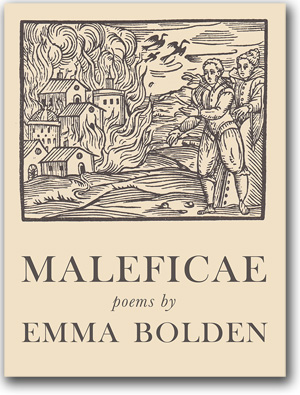
    malificaecoverFinally, a brief word: there’s been a great deal of talk about witch trials lately, and it feels very serendipitous that my first full-length collection, Maleficae, has gone into a second edition and is once again available for purchase on Amazon (signed copies are also available — just send me a note via the comment page!). The book tells the story of a midwife/healer tried and executed as a witch during a real and actual witch trial. It also explores the forces that led to the trials, during which over one hundred thousand people were killed. The material felt urgent when I wrote it, but it feels infinitely more urgent now.

  • If you’re looking for warmth this cold February Sunday, I’ve got three poems out in the online world to keep you company.

    First up is “Edit,” published in the Fall 2016 issue of Causeway Lit. I’m proud to say that it won first place in the Fall 2016 contest, and poetry editor Lauren Palmbach wrote a very kind and sweet note that you can read here. Thank you, Lauren!

    Second, you’ll find “Deposition: On That Night & All That Was After” in the latest issue of Josephine Quarterly.

    Thirdly, you’ll find my poem “As One Would Imagine After” on the Blue Mountain Community College website. The poem received an honorable mention in what’s probably one of my favorite competitions: the Warming Station Poetry Contest, the proceeds of which benefit the Pendleton Warming Station in Pendleton, Oregon.

  • I’ve got three poems up in the new issue of TriQuarterly: “Yes, I Would Like to Imagine the Self,” “The Imposition of Ashes,” and “Hysterectomy/Recovery.” There’s a recording of

    28245041004_3852eb7130_z
    The poems are a little sad, so I decided to include a photograph of Gertrude Stein in the middle of doubting one of my promises.

    me reading each poem, which you can listen to while looking at a photograph of the time I tried to do Valley of the Dolls hair and failed, which is posted next to my bio on the page. While you’re there, you should definitely think about Valley of the Dolls and how amazing it is for a while. When you’re finished with this important meditation, you should totally definitely visit the rest of the pieces in this issue, which are amazing and authored by some of my very favorite writers, including Maggie Smith, Emily Jaeger, Ruben Quesada — pretty much everyone in the issue, to be honest, and it’s an honor for my work to appear with theirs.

  • 24155002595_7be8cc2ff3_k

    I’m going the start this, my final blog post of 2016, with what remains the strangest, most surreal, most amazing and wonderful and exciting sentence I have typed to date: I’m humbled, honored, and honestly still just super shocked to say that I was the recipient of a 2017 Creative Writing Fellowship in Poetry, which comes with a grant, from the National Endowment for the Arts.

    No, seriously. I’m on the list. I know that because I’ve looked at it about seven thousand times, sure that they mean some other Emma or they’ve made a typo or I’ve lost my reading comprehension completely. It’s still there, every time I look at it, so it must be true.

    Here’s the thing about 2016: it really has been a dumpster fire of a year, hasn’t it? It feels as if, this year, many of us woke and walked into a new world, one mapped in lines of love lost, hate hungering, and grief grabbing hold of and shaking us to our core, over and over again. It’s been that way for me, at least, and on so many levels, from the personal to the professional to the political. When I look back at the notebooks I’ve kept over the course of the year, I see fear that blossomed into terror, loss that sank fully into inconsolable sadness, confusion that collapsed into chaos, and desperation that deepened to the point of desolation.

    That’s not what I’m here to talk about.

    That’s not what I’m going to think about, during the last day of this strange, sad, surreal, and somehow joyful whirlwind of a year.

    I’m here to talk about dedication, persistence, and faith.

    I’m here to talk about hope.

    This is the sixth time I’ve applied for the NEA Poetry Fellowship. It’s the eighth time I’ve applied for an NEA Fellowship, if you include two (possibly misguided) applications for the prose cycle. I almost didn’t apply this year. I’d been rejected so many times and besides, I was at a very low point in my life when the deadline came around. I found myself in a state perhaps described best as an identity crisis: everything was unrecognizable, including myself. My confidence in myself and my work and my words and my everything plummeted. I felt as if the time had come for me to make drastic moves, but I felt at the same time paralyzed.

    I felt as if I’d lost my luck, but I also felt luckier than I have in years. That’s because I  was lucky enough to be surrounded by an indescribably amazing, strong, and beautiful group of co-workers every day — and here’s where the hope comes in. I couldn’t believe in myself, but they did. I gained the confidence to start writing and to start sending work to journals — and applying for grants, like the NEA Fellowship, again. We went through much of the dumpster fire of 2016 together, and, for me at least, it’s the togetherness that saved me. It’s that togetherness that gave me hope, that helped me to see that even if it feels as though you’ve lost everything, you still have your voice and the right to use it. It’s that togetherness that taught me to look for the good in the garbage, to fight for what’s right, to stand tall and speak out in the face of evil, and that when women gather together, it’s pretty clear that girls can rule the world with a sense of grace and compassion that defines strength. Through their love, I learned how to love myself again.

    Though these women aren’t physically present in my day-to-day life anymore, I carry what they taught me in each moment of each day. I’ve also learned how important it is to have a community of writers who celebrate each others’ successes and comfort each others’ griefs. I will be totally honest and confess that I’ve never really felt entirely part of a community of writers until recently. I will be even more totally honest and say that that’s probably almost entirely my fault: I have a hard time trusting and having faith in others, probably because I have a hard time having faith in myself. This year, with a lot of help, I’ve managed to push past these roadblocks and find the indescribable beauty that comes when people come together to hold each other up — and to figuratively hold hands, shoring each other up and fighting as a community for what is right. There’s no denying that writing is a terribly lonely profession, but I also can’t deny that circling up in a supportive community has profoundly changed the way I work as well as the way I look at the work of making art and releasing it into the world.

    I guess what I want to say is this: keep going. No matter how dark it seems, no matter how far you seem to be from the light, keep going. Keep writing. Keep sending out and sending out, and remember that every rejection is evidence that you are doing the good work your work deserves. Find people who love you and love them back. Find faith. Find persistence. Find confidence. Never let go.

    I didn’t think that I’d find myself, at the end of a year I’ve cursed and cried through, full of hope and determination, ready to face whatever comes in 2017. Now I know, more than ever, that it’s time to come together, to hold each other up, and walk together as one body, fighting for the light.


  • I’m proud to say that I’ve got a poem in the latest issue of one of my favorite journals, Waccamaw. I’m really attached to this poem and excited about its publication for a couple of reasons. The first is the story behind it, which begins (yet again) at the end of a writing-

    fullsizerender4
    This is a totally metal x-ray of the metal screw in my mouth. \m/(>.<)\m/

    a-poem-a-day project (this is becoming A Thing, I’m noting to myself, and I should probably get back on the writing-a-poem-a-day horse and see where it takes me) (Internets, keep me to it). I was feeling dragging-the-dregs desperate, and took a break from poeming to talk to a friend of mine. She’d spent the morning at the doctor’s office with her daughter, looking at X-rays to determine if she’d broken her leg. She’d worked at a doctor’s office herself and remembered that the man who discovered the x-ray, Wilhelm Röntgen, experimented on his wife first. I mentioned the trouble I was having, dragging the dregs for a poem. “Write about x-rays,” she said, and I decided to take the assignment. I started by doing the last thing anyone wants someone to do by way of starting an assignment: I looked at Wikipedia. That’s where I found out that Röntgen’s wife said “I have seen my death!” when she saw the x-ray of her hand, which gave me chills — and which, in turn, gave me this poem.

    The second reason I’m excited is that, y’all, this poem has made the rounds a lot. Like, a lot. I’ve been sending it out for two and a half years, polishing and re-polishing every time it came boomeranging back to me. It was rejected so many times that I was on the verge of pulling it, but I decided to try one more time. Thankfully, Waccamaw decided that this was the time for this poem to appear onscreen.

  • I thought that I knew the world, but I had only looked. I had not seen. I had not recognized that looking was not seeing, that seeing was witness, that the privilege of living in a place of looking came with the responsibility to recognize, to act, to aid. I had looked and I had not seen. I had not realized that the borders between worlds and loves and lives were not borders but lines of separation set into the mind by the privilege of looking. I had not realized the responsibility of my eyes to see and not look, of my hands to reach out and give, and give, and give.

    19856479070_8253641a27_z

    The above paragraph is an excerpt from my essay, “Between Looking and Seeing,” which appears in the Fall 2016 issue of Origins. The theme of the issue is “witness,” and it’s the theme of the essay, too — in it, I consider the difference between seeing something and witnessing something, between standing by and acting, between ignoring and bettering. In a way, the writing of the essay itself has been my own journey towards trying to figure out how to speak and act for the good of all instead of acquiescing with silence. The essay has seen more deconstruction and reconstruction than the average episode of Fixer Upper (PS I love you, Jo!). I wrote the first draft five years ago; in its initial incarnation, it juxtaposed paragraphs about the Tuscaloosa/Dolomite tornadoes in April of 2011 with scenes from a relationship. Even now, just writing that sentence, I can see the problem that took me all five of the intervening years to figure out: to employ a tragedy as a metaphor was a terribly irresponsible, dangerous, and damaging thing for me to do. I considered giving up on the essay, but something just kept nagging me. Sometimes, I think a piece of writing or an idea just won’t go away because there’s something larger about the working-through of it, something important to learn or to say. I think that was definitely the case here. In the incarnation of the essay that appears in Origins, I confess, and I grapple with the ideas of witness, responsibility, and right action.

    I also want to give two thank you’s, at the risk of moving too extremely into a different tone that commits some of the sins mentioned in the previous paragraph (“Do I contradict myself? Very well, I contradict myself.”). The first thank you goes to the editors of Compose, who kindly nominated my poem, “House Is A Hoard,” for a Pushcart Prize. The second thank you goes to Kristina Marie Darling, whose beautiful essay “’My Heart Pedals Shut’: On Distance, Desire, and Lyric Address in Recent Poetry by Women” appears in the latest issue of The Literary Review. The essay discusses my chapbook, The Sad Epistles, and Megan Kaminski’s Desiring Map. It’s humbling to have my work discussed at all, especially in such good company, so I’m just very, very grateful about this.

  • I’m proud to say that I have a poem, “The Coyote Doesn’t Have To,” in the Fall 2016 issue of Amethyst Arsenic. I’m ecstatic to see this poem roaming out in the wild, and I can’t thank guest editors Staci Schoenfeld and M. Brett Gaffney enough.

    6407995641_b3a738b1e8_z

    I wrote the first draft of this poem in April of 2014. That was, of course, National Poetry Month, which meant that I was writing a poem every day of that month. I was particularly lucky during that particular National Poetry Month because I wasn’t writing alone. Instead, I shared a collaborative writing space in the form of a blog with students and fellow faculty members. This poem arrived at the end of the month, and I remember feeling strangely vulnerable when I posted it. I’m not sure that, even now, I can articulate the reasons why. I do know that this poem originated in one of those faraway moments of fear that happen in childhood and haunt adulthood. When I was six years old, my parents and I moved from Alabama to Arizona. I was the kind of child who got upset when lunch plans changed; needless to say, I did not adjust well. We lived on the edge of the desert with only a concrete bricked wall between us and the Saguaros and sand, and I was terrified. Every sound, every rustle, and — especially — every howl made me bristle with fear.

    That’s where the poem started.

    I had a lot of faith in this little poem. Even though I felt vulnerable about it, I still felt as though there was something important about it. I sent this poem out over and over again and it was rejected over and over again. I’m glad about that, though, because I feel like this is the exact right moment for this poem to make its way out into the world.

    The reason for that is that the poem didn’t end in the same place in which it started. In fact, the poem ended up in the very opposite place. When I wrote the poem, I began in that howl, that moment of wordless, inchoate fear. However, as I wrote, as the coyote began to move across the page, gathering muscle and teeth and fur, I felt the moment change. I began to empathize with the coyote, who, I discovered as I wrote, was a female. I began to see her not as a destroyer but as a creator, as a protective force who would fight any evil enemy in all of that darkness to save what she loved. The coyote’s howl became a war-cry of power, a clarion call for strength, and a warning for any beast who tries to come for all that she held holy.

    There is no better time for that energy to be released into the world.